Understand
Assess your operating model, systems and constraints to find where technology can create real value.
Connect software, automation, customer systems and digital protection to real operating needs.
The right technology architecture reflects real workflows, sound information practices and the people responsible for maintaining it.
Use-case assessment, process mapping, assistive workflows and supervised automation.
Explore AI & Automation STRATEGY / ARCHITECTURE / IMPLEMENTATIONPurpose-built internal tools, integrations, customer experiences and product engineering.
Explore Custom Software STRATEGY / ARCHITECTURE / IMPLEMENTATIONPipeline design, lifecycle processes, service workflows and data handoffs.
Explore CRM & Workflows STRATEGY / ARCHITECTURE / IMPLEMENTATIONCyber risk review, managed defense options and appropriate security implementation.
Explore Cybersecurity STRATEGY / ARCHITECTURE / IMPLEMENTATIONUnderstand the process before adding automation.
Access, privacy and security requirements are part of the scope.
Document ownership, exceptions and maintenance before launch.
Digital projects often inherit contradictions from the business. Different departments maintain different definitions of a customer, duplicate records because integrations are missing, or purchase software without deciding who owns the underlying workflow. A new tool can improve the interface while preserving the broken handoff.
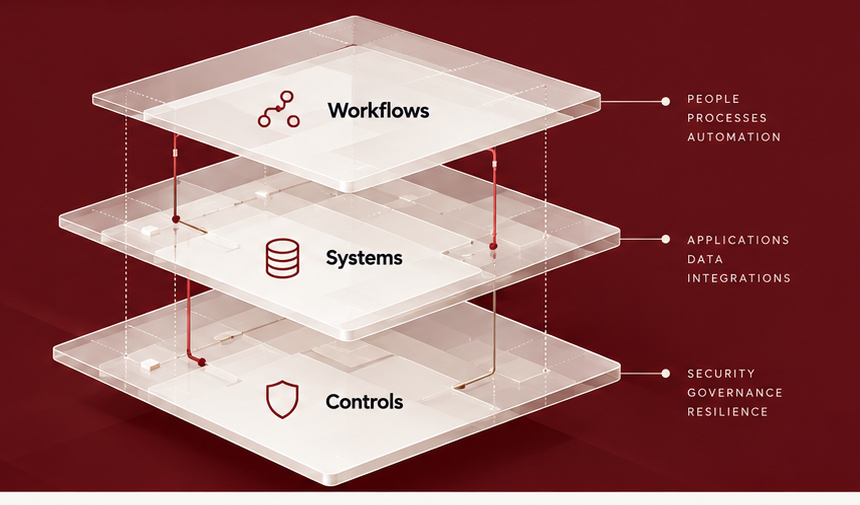
We examine people, process, data and controls as a single design problem. The right solution may be configuration, integration, bespoke software, supervised automation, security improvements or a change in governance. Security and maintainability deserve early consideration because every new connection and permission creates a continuing responsibility.
Which system is authoritative for each important fact?
Data definitions, owners and synchronization rules.What triggers the next action, and who handles an exception?
Process map, escalation and operational capacity.Who may access, change or approve sensitive information?
Identity, permissions, logging and recovery practices.Who can maintain the solution when the initial project ends?
Documentation, support, testing and change management.A company asks for an AI assistant to summarize customer status. During discovery, the same customer has different statuses across sales, support and finance systems. The assistant could produce a fluent answer, but not necessarily a correct one.
A better first decision may be to establish data authority and integration rules, then pilot a supervised assistant with clear limitations. That sequence can seem less exciting than a demonstration, but it addresses the actual operating risk. The scenario is illustrative.
Start with the decision or workflow that is failing. Select technology after defining the owner, data, controls and acceptable exceptions.
Start with the work that is slow, fragmented or difficult to control.
Discuss an Engagement