Shipment visibility breaks down between providers or locations.
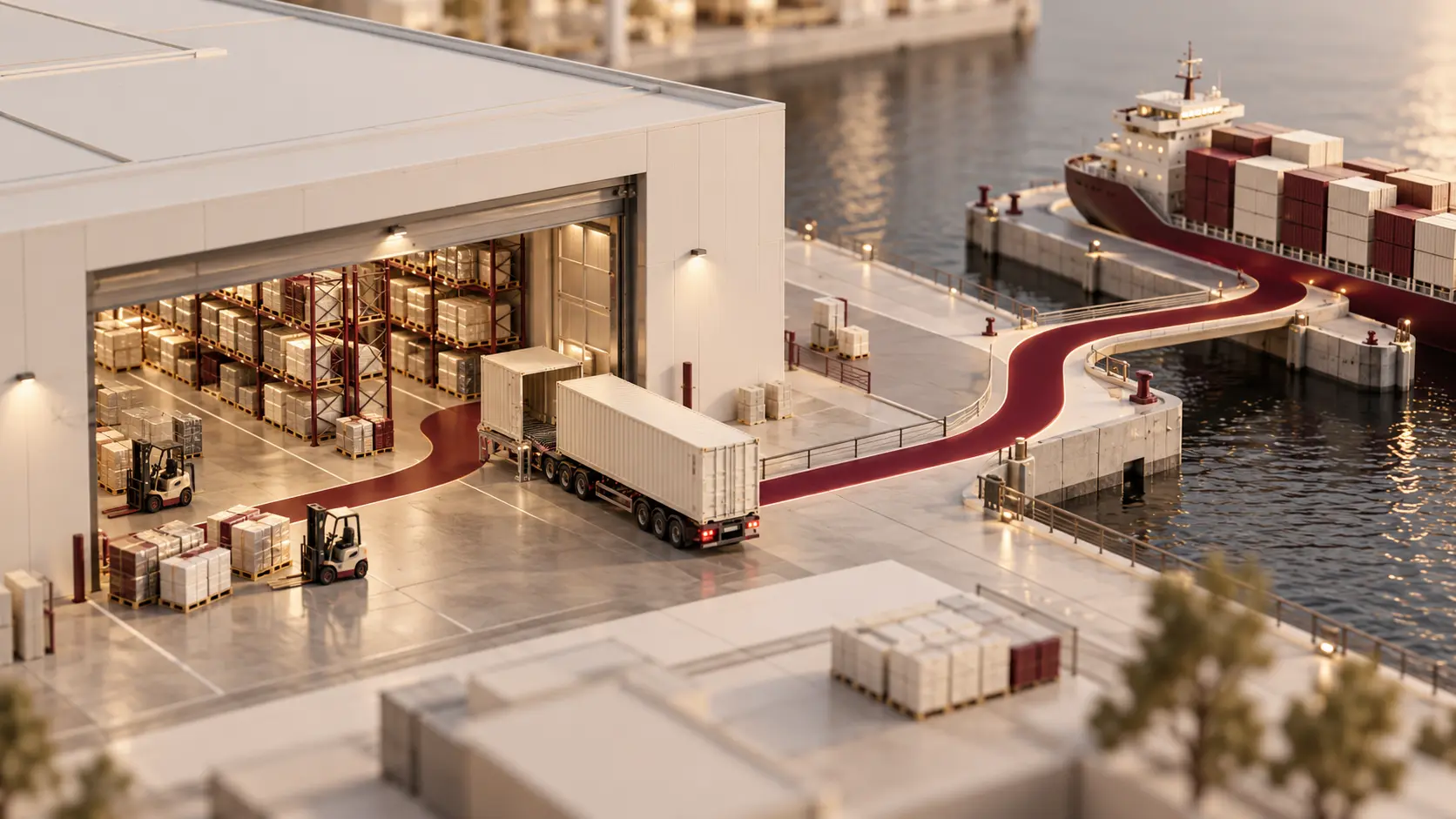
02SUPPLY CHAIN & PRODUCT / LOGISTICS & FULFILLMENT
The promise is not complete until delivery works.
Connect freight, warehousing, distribution and fulfillment planning to real service expectations and cost constraints.
BEYOND THE SERVICE LIST
The shipment has not become simpler because its cost appears on one line.
THE DECISION BEHIND THE WORK
A supply promise is a network of responsibilities.
The customer experiences delivery as one promise, while the operation may involve several carriers, warehouses, customs parties, systems and service providers. Each transfer can introduce a gap in timing, status information or accountability. Reliability improves when those dependencies are planned together.
Network design requires a realistic view of inventory locations, order characteristics, lead-time variation, service targets and total cost. In international movements, landed cost can include duties, taxes, brokerage and other charges that change by destination and product. Trade terms should clearly allocate responsibilities and risk. A cheap freight rate is not a complete logistics decision.
THE OPERATING REALITY
Every transfer of custody is a point of uncertainty.
Timelines, inventories, carrier choices and customer promises rely on different operating assumptions. Coordinated planning can reduce surprises before they become expensive exceptions.
Fulfillment cost and service targets are planned independently.
Stock, lead times or exceptions are communicated too late.
WHERE WE FOCUS
Treat movement as a connected operating system.
Map the flow and the responsibilities from origin to delivery, then make the handoffs measurable.
Flow and network review
Map shipping lanes, cross-border obligations, order volume, inventory points, returns and customer delivery expectations.
Provider and option assessment
Compare suitable freight, 3PL warehousing, fulfillment or coordinated 4PL models on coverage, integration and total landed cost.
Operational coordination
Define order and inventory data exchange, carrier booking, custody transitions, customs support roles and exception escalation.
Service and cost review
Review tracking completeness, pick-and-pack accuracy, delivery reliability, returns and contract service limits.
An end-to-end delivery cost map
The delivered unit cost tells a fuller story.
Compare routing and fulfillment decisions against the cost, reliability and information required at each handoff.
DECISIONEVIDENCE TO MAKE VISIBLE
Movement
Which route, mode and transfer are assumed?
Transit, incoterms and custodyHandling
What happens at the nodes?
Warehousing, packaging, exceptions and returnsVisibility
How are delays and loss surfaced?
Events, carrier evidence and escalationWhat the first working output might be
Possible first output: a lane-level cost and exception map with identified control points.
Important limitation: Transit estimates and carrier service commitments are not guarantees of arrival.AN EVIDENCE-LED REVIEW
Follow the order from promise through proof of delivery.
These are useful lines of inquiry, not a universal checklist. The specific evidence and scope depend on the business context.
Service definition
What delivery commitment has actually been made?
Clarify order profiles, deadlines, destinations and exceptions.
Cost and capacity
Where is inventory held and how is movement priced?
Review handling, storage, freight, returns and landed-cost assumptions.
Exception ownership
Who responds when the route deviates?
Map statuses, escalation, claims and customer communication.
ILLUSTRATIVE OPERATING SITUATION
Fast sales growth reveals an expensive fulfillment model.
This is a hypothetical example for explanation. It is not presented as a client engagement or result.An ecommerce brand adds new markets and begins shipping from one central warehouse. Order volume looks healthy, but delivery promises become inconsistent and rush charges increase. Teams optimize individual carrier rates without examining inventory placement and order mix.
A useful review would segment orders by destination and urgency, map the end-to-end costs, examine warehouse and carrier options, and define realistic service commitments. The solution might include better routing, changed inventory placement or more accurate promises, not simply a new freight contract.
BOUNDARIES AND RESPONSIBILITY
A quoted transit time is a forecast.
Carrier performance, weather, border conditions, duties and infrastructure are subject to external factors. Service commitments and trade responsibilities require agreed terms and current local compliance advice.
Independent reference: U.S. International Trade Administration on landed cost ↗. This source informs the topic; it does not endorse Avermont Partners.
QUESTIONS WORTH CLARIFYING
Who responds when the shipment deviates?
An informed first conversation is often more useful than a prematurely detailed proposal.
Is the lowest freight rate the most economical?
Not necessarily. Storage, handling, reliability, customer service, returns and import costs can change the total economics.
What does visibility need to include?
At minimum, the stages that support operational decisions: current location or status where available, expected handoff, delay conditions and a named party responsible for action.
How should global trade terms be handled?
The agreed Incoterms rule, named place, transport mode and contractual responsibilities should be explicit. Specialist trade advice may be needed for customs and regulatory requirements.
THE QUESTION WORTH ASKING
Where does your visibility stop before the shipment arrives?
Useful progress begins with a clear requirement, the right evidence and ownership of the next decision.
View all Supply Chain capabilitiesTHE NEXT CONVERSATION
Make fulfillment a reliable commitment.
Share the situation, constraints and intended outcome. We can then assess whether a focused engagement would be useful.
Discuss an Engagement